





The will and determination that NASA is showing in the exploration of Mars with all available means are certainly not new. At the continuation of this real enterprise, a new space mission is planned, scheduled for April 8, which includes the release of the first drone-helicopter "Ingenuity", currently located at the bottom of the Martian rover Perseverance, followed by its first round of exploration of the territory around him.
NASA said it has already scoured the surface of Mars in search of an "airport" for the launch, using satellite images and captured by Perseverance. Unlike rockets launched so far, the purpose of Ingenuity will not be to conduct scientific experiments, but "simply" to test its strength and efficiency after landing. The goal is to make it, in the future, an assistant for engineers and scientists in multiple fields of application.
Nasa said that there are a number of challenges that need to be addressed before the trip can take place, the first lying in fully understanding the host planet's harsh atmosphere, including the winds. There are also a number of risks and hazards, including the possibility of Perseverance losing sight of the helicopter. Another critical issue is related to the great distance between Mars and Earth, it implies the impossibility to control the helicopter live, to the point that messages can take 5 to 20 minutes to arrive at their destination. Perseverance will therefore try to take images and videos of the trip, although Nasa engineers have noted that it will be difficult to ensure that the two means can always communicate properly.
It is therefore evident that, having to fly a helicopter at a considerable distance from the control center (about 300 million km), it is necessary to have a knowledge of the weather conditions as precise as possible, in order to avoid inconveniences. To try to imagine the complexity of the issue, just think that the atmosphere on the red planet is only 1/100 more dense than the Earth's, while the gravity is less, about one third of ours. In addition, the temperature and wind speed must be taken into account, measurements that can be collected by the MEDA instrument on the Perseverance rover. The knowledge "in real time" of these parameters could allow to adapt accordingly the flight parameters.
Engineers are also keeping an eye on the Sun and its coronal mass ejections. This is because the drone-helicopter has some components exposed to possible problems with charged particles from our star that could affect its operation.
The drone-helicopter has a rather simple construction and an approximate cost of $ 85 million divided into $ 80 million for development, testing and construction and $ 5 million for the estimated operational life of 30 days. The optical instruments on board Ingenuity are not particularly advanced, they are in fact two cameras that should allow the drone-helicopter to fly safely and autonomously and perhaps to have some images taken from above.
The helicopter's square fuselage, which houses computers, cameras, batteries, etc., is the size of a softball (20 x 16 x 14 centimeters) while the two 1.2-meter wide rotors make stowing and deploying the helicopter a challenge. The deployment process from the rover begins with the release of a locking mechanism that holds the helicopter in place. Then, a wire-cutting device is fired, allowing a spring-loaded arm holding the helicopter to begin spinning Ingenuity out of its horizontal position. Finally, a small electric motor will allow the helicopter to position itself vertically with two of its spring-loaded landing legs deployed. Finally, another pyrotechnic ignition will release the other legs. From this point on, once separated from the rover, Ingenuity can be recharged solely through the upper solar panels.
The engineers' goals are to achieve at least 90 seconds of flight time, covering a distance of 300 meters at a maximum height of 15 meters. Soaring over the Red Planet is equivalent to flying from an altitude of 100,000 feet above the Earth. No existing helicopter has ever been so high, in fact it is an altitude that is more than twice that at which jets normally fly. To add to this aspect, is the complete automation of the flight, widely discussed above.
Written by Alessandro Celli of the VGen Engineering Hub
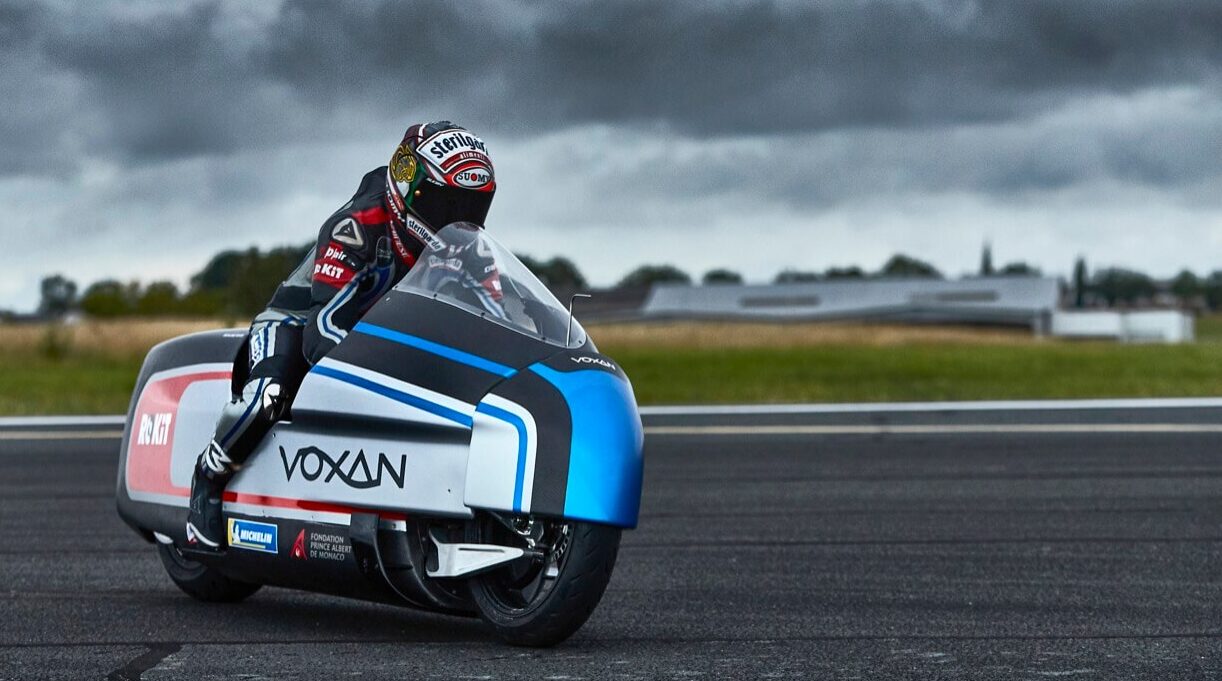
The pairing of Max Biaggi and the world of two wheels continues to amaze well beyond the rider's retirement from moto Gp in 2005 and from superbike in 2015. The former world champion has accepted the challenges of breaking a series of records aboard a motorcycle, electric, in November 2020.
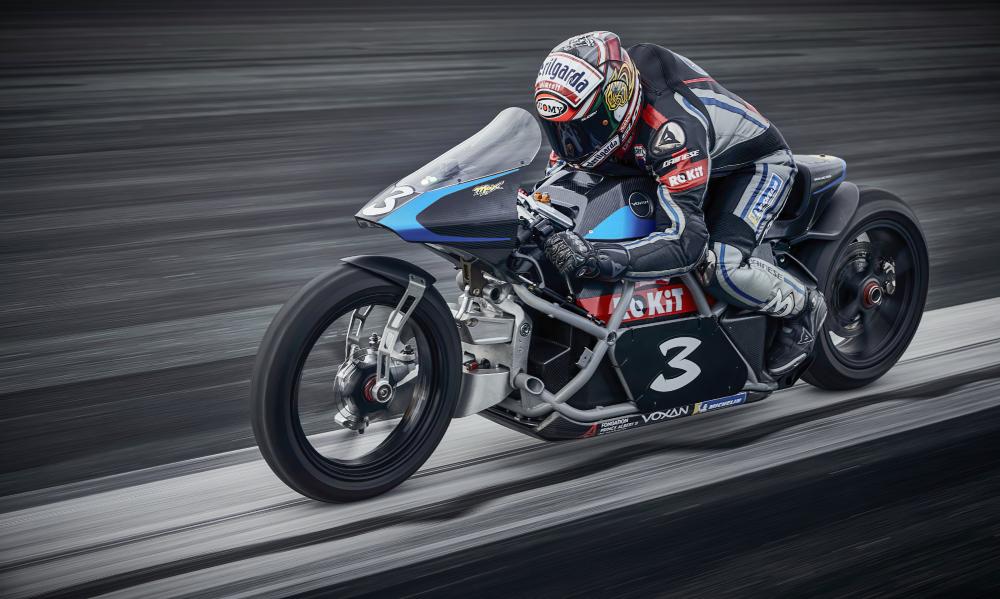
The bike in question is the Voxam Wattman, developed by the Venturi brand of Stuttgart. It is an electric two-wheeler with dimensions of 2,700mm in length, 710mm in width and 1,030mm in height. The Voxan Wattman boasts some special technical features that set it apart from conventional motorcycles. For example, in order to maximize the distance between the front and rear wheels (a longer wheelbase provides more stability), Voxan engineers designed the bike with a double-arm front suspension instead of using a telescopic fork. This solution reduces drag while allowing for quicker and easier replacement. The bike is designed in such a way that the rider is seated in a more rearward position, allowing the center of gravity to be lowered. The frame, on the other hand, is made of aerospace steel, while the racing gearbox and wheel rims are made of aluminum.
Due to the limitations imposed by the weight of the battery (nearly 50% of the Wattman's total mass) and the level of performance required, there was no battery on the market that would fit those requirements. So Voxan Motors engineers designed Wattman's new power unit. The challenge was finding parts that offered the best possible power-to-weight ratio. With 1,470 cells (and a weight of 140 kg), the Voxan Wattman's battery delivers 317 kW of rated power, with a capacity of 15.9 kWh.
The Wattman does not have a conventional cooling system. It has no radiator, which is seen as a disadvantage from an aerodynamic point of view. To avoid overheating, the fluid in the circuit is cooled by dry ice, contained in a tank mounted under the seat. The cooled fluid is then pumped through the cooling circuit that runs through the heart of the powertrain.
A total of 11 speed records have been set by Max Biaggi aboard the Voxam. Initially, the record attempt was supposed to take place on the Salar de Uyuny, the world's largest salt lake in Bolivia, but due to restrictions imposed by Covid-19, the location chosen that would have guaranteed the ideal conditions on the track was the French airport of Chateauroux. Among the records we would like to underline the records on the quarter mile and on the one mile with standing start and with rolling start. In both cases the race was run with a partial fairing and not.
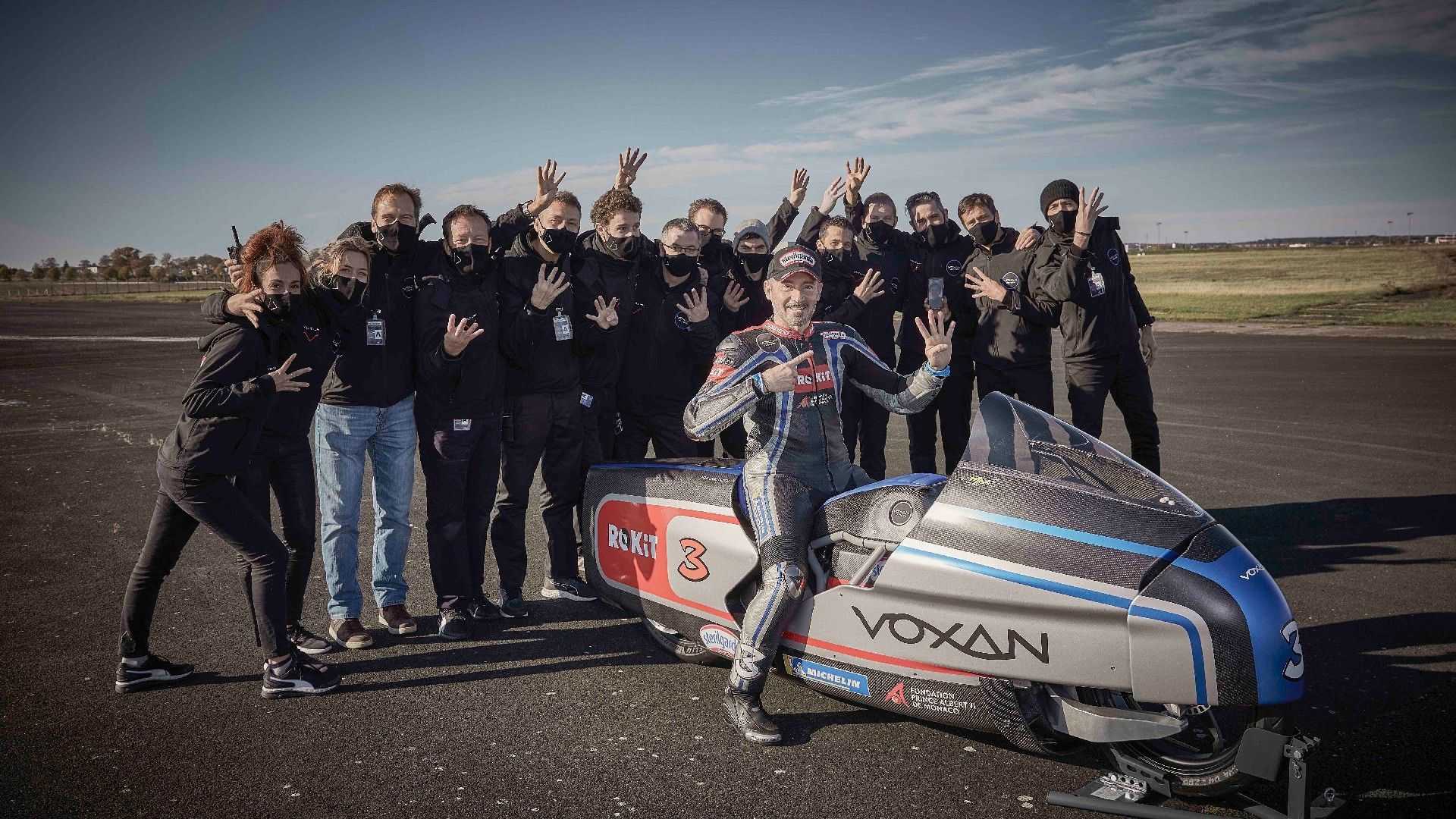
The main record is definitely the top speed set aboard an electric motorcycle on the morning of October 31, 2020. According to measurements, the GPS speedometer of the Voxan Wattman reached a top speed of 408 km/h. The speed of the Voxan Wattman, belonging to the semi-streamliner class (with partial fairing) over 300 kg, piloted by Max Biaggi, was measured from a rolling start of over 1 mile in opposite directions, over a period of two hours.
According to FIM (Fédération Internationale de Motocyclisme) regulations, the average speed recorded in these two races was 366.94 km/h, beating the result achieved by Ryuji Tsuruta and the Mobitec EV-02A of 329 km/h in 2019.
However, the Voxam team has declared that it does not want to be satisfied with the exceptional results obtained but has communicated that it wants to continue to amaze, committing itself to be able to establish an average speed of about 400 km/h in 2022, while currently the average speed obtained is 'only' 366.94 km/h.
Max Biaggi's words at the end of the race were the following: "I've never touched 400 km/h, and believe me, around these speeds the perspective of the space around us changes completely. Aerodynamic effects become decisive, the air is a practically impenetrable wall and you begin to fight with forces that up until that moment were little known. Holding on to the bike while trying to reach speeds that were unimaginable to me was a new challenge for me."
Written by Alessandro Celli of the VGen Engineering Hub

Following Elon Musk's announcement of the Neuralink project, the attention of many has focused on the development of new nanotechnology in the fields of medicine and bioengineering. In recent months, a team of researchers at the Micro Nano Research Facility (MNRF) in Melbourne has created a nanocell capable of simulating the human brain. No device had so far come so close to the real behavior of our brain, as it is able to base its evolution on previous experiences.
THE TURNING POINT: THE MEMRISTOR
The ultrafast cell developed at MNRF works as a memristore, a passive nonlinear component capable of changing its electronic characteristics according to the voltage applied to it. Unlike traditional CMOS cells (which can represent only two logical states, namely '1' and '0'), it allows the creation of multilevel memory cells, which are well suited to the simulation of synaptic junctions. Just think of an electric dimmer that unlike a normal on / off switch, allows you to adjust at will the brightness of the bulb.
When a potential difference is applied to the electrodes, a current flow is obtained and a consequent change in the conduction capacity of the material, thanks to which it is possible to emulate an important biological function of synapses, namely synaptic plasticity (ability of the nervous system to change the intensity of the relationships between neurons, to establish new ones and to eliminate some of them).
The change in resistive state can be maintained even after the electrical signal is removed. In this way, the memristor is able to preserve the history of previously applied electrical stimuli.
Similarly, the human brain, based on past experience, modifies the tendency of the electrical impulse to travel through each interneural connection: the so-called "synaptic weight" is represented by the variation of the resistance of the memristor.
MATERIALS AND STRUCTURE
The electronic cell was created on a nanofilm composed of an alloy of oxidized metals, including Titanium and Strontium, which following previous studies had proved to be the most suitable for applications of this type. Oxidizing the semiconductor (Sn, Strontium) with molecules of TiO3, we obtain a material with excellent memristive properties, which can be amplified with a further doping by acceptor atoms.
CONCLUSION
The development of this new technology opens the way not only to structures able to host more and more complex neural networks and artificial intelligences or to the design of smaller but at the same time larger memories, but also to a progress in the biomedical field: getting closer and closer to the real electrical functioning of the human brain, it would be possible to observe more closely the evolution of neurodegenerative diseases and, at the same time, to conduct experiments without worrying about ethical barriers. So we can expect a continuous and growing development of memristor technologies, which will become more and more used in every technological field for its immense potential.
Written by Sebastiano Vittoria e Marco Vitali del VGen Engineering Hub

"There is nothing more risky than the widespread perception that there is no risk" (Howard Marks).
For this reason, the GameStop case is destined to make history. A social phenomenon, even more than a financial one, that between 2020 and 2021 has become a mainstream issue and on everyone's lips, experts or not. At the beginning of 2020, after a long descent, GameStop's share price was around 4$ and was the most sold short on Wall Street. Company unable to generate profits since 2015 and anchored to a business model now in the twilight of its best days, the historic Texan reality, which with its stores has accompanied entire generations of fans of the gaming scene, no longer seemed able to give us great emotions. In our world, however, sometimes rationality falters, and so in January 2021 GameStop's stock rose by 1844% in a few days, reaching the price of $347, but then, predictably, collapsed again and then experienced a new growth in March, confirming the high volatility of the stock following the events of January. What has happened? Who is responsible? What are the consequences? What does the future hold for us? Let's find out together by analyzing the phenomenon a few months later.
Gordon Gekko in the famous movie "Wall Street" claid "greed is good".
The army of retail investors who have flocked to GameStop stock must have taken Gekko's famous quote particularly seriously. But you know, where populism, social media and cheap money combine, interesting things always happen..
Let's start by defining the typical profile of the retail investor. We are talking about savers - including companies, corporations or other entities - who do not qualify as professional clients. They usually have small amounts of money to invest and a rough knowledge of the financial markets. They often turn to specific intermediaries looking for the best combination of cost/availability of securities.
In this case, aided by brokers' zero commissions, the possibility to invest in very small amounts, the word of mouth on social networks and the considerable free time allowed by covid, retail investors organized themselves in real bullish locusts. Add to the recipe the massive purchase of deep-out-of-the money options, exercised on stocks heavily shorted by institutional investors and...
Les jeux sont faits, rien ne va plus, as in the most dangerous of casinos, an unwise bet on the upside becomes a financial accident of global proportions..
If you look closely, the last mini financial bubbles have been generated by a massive intervention of retail investors (see cryptocurrencies, Hertz, Blackberry, etc.)
Bank of America and Credit Suisse confirm, in their reports, an unusual relevance of the retail segment in the rise of prices in recent years. This is probably due to the great increase in downloads of trading apps (Robinhood in primis) and the great amount of liquidity recently injected into the market, which has gone to flow into equity returns rather than negative bond rates.

On the other hand, we have several large hedge funds and financial institutions forced to close short positions worth billions, due to the stock's continued baseless rises.
It became famous the case of Melvin Capital Management, which betting on a collapse of GameStop lost in January $6.6 billion, and was saved thanks to the injection of $2.75 billion from the hedge fund Citadel, which allowed it not to have to liquidate its other investments as well.
The financial world is not a game, and savvy players (hedge funds) started with the logical and realistic consideration that GameStop at $40 was overvalued.
Small investors on Reddit, evidently of the opposite opinion, started from the consideration that hedge funds should be stopped, regardless of a logical reason, without thinking about who would pay the consequences.
This is where the "clash" between small investors and large funds, small versus large, begins.
But let's take a step back.
A recent research by Valentina Semenova and Julian Winkler has highlighted the presence of a phenomenon called "social contagion" or, more commonly, hype: in the paper, it is estimated that among the users of WallStreetBets the probability that an individual starts a new discussion about an asset is about 4 times higher if that user has previously been involved in a discussion about the same asset. In addition, the historical intent of groups such as WSB to obtain large gains with high risk operations generates the so-called "narrow framing": this theory, part of Behavioural Economics, argues that the choice of the individual investor is dictated by the exposure to a specific position (in this case within the forum), which leads the individual not to assess the risk independently (and using their own information) but rather to rely on the (non-)perceived risk.
In two words, the infamous "herd behavior" manifests itself in all its (ambiguous) magnificence.
In this case, however, the dynamic took on a different connotation, almost subversive, from the revolutionary objective.
From a social point of view, in fact, the phenomenon has taken on an unusual relevance: the "redemption" of small investors who join forces against the "strong powers" of finance, manipulating the market as the big funds have been doing for decades. In a David versus Goliath perspective, retailers have banded together (perhaps illegally) to manipulate the market and bring down the giant. Why is this happening at this moment in history? Why has a practice that has been widespread for so many years only now received such an attack? One possible reason is again given by Behavioural Economics, and in particular by the simil-Newtonian Reciprocity Theory, which argues that individuals are inclined to respond to a negative action with an equally negative one. It is possible that an unprecedented situation such as the pandemic has made, in the eyes of some investors, the actions of hedge funds unacceptable and therefore deserving of punishment, thanks also to the aforementioned increasing accessibility of markets and interactions with other investors made possible by social networks. In this regard, Chohan (2021) argues that this behavior can also derive from ill-concealed revenge for the 2008 financial crisis, in which hedge funds would have played a fundamental role. According to this theory, David would have filled his slingshot with all the anger he had felt over the years and would have hurled his revenge at the giant with all his might. However, biblical comparisons are often destined to remain only on paper, and it matters little that the major entities operating in the financial markets offer liquidity, market making and guarantee services, as well as being highly regulated and controlled.
In these cases, perspective makes all the difference in the world, and most investors operate in a complex system of asymmetric information.
We therefore analyze the different perspectives to better understand the phenomenon in its entirety:
1. The small investor: happy with his incredible earnings with minimal capital, he feels satisfied and fulfilled by his genius. While thinking about how many Ferraris he will buy in the next few days, however, he ignores a small detail. Within those billions of dollars burned by investment funds is his own retirement fund and that of his family members. The big funds like Citadel and Point72 for example have many of the most common pension and insurance funds under management. Unaware of this he continues to buy GME stock until the stock crashes miserably, ending his dreams of living a life like "The Wolf of Wall Street."
2.Hedge funds: burned by the lost bet are running for cover through their hedging instruments. The Risk Management division has some bad nights ahead, and some heads will probably roll. The next time they open a short position a more thorough analysis of short squeeze risk will be done. The losses are severe but recoverable. A few funds will be recapitalized through internal and external capital injections. And some executives will probably forgo their million dollar bonuses this year.
3.Gamestop's big shareholders: here the best of paradoxes comes into play. Among GameStop's largest shareholders we find in fact besides Ryahn Cohen, founder of Chewy.com who owns 12.9% of the shares and triggered the first upward speculation, Fidelity (13.6%), BlackRock (13.2%), Vanguard (12.9%), State Street (3.7%), Norges Bank (2.6%), Invesco (1.5%) and some of the world's top pension fund institutions. These funds are estimated to have earned about $16 billion in capital gains, due to rising stock prices.
Based on JPMorgan's calculations, it can be assumed that behind the "GameStop phenomenon" there was the paw of institutional investors, much more active than has been said so far. No David against Goliath. It could simply have been a war of "Wall Street against Wall Street".
By analyzing the different perspectives, we understand how the "social anger" that has generated the roller coaster of the last few months has proved counterproductive first and foremost for the small investor, not possessing sufficient capital to cover the risk and the adequate knowledge to close the position at the appropriate time. The origin of these movements is to be found in a process of "democratization" of finance that has been underway for some years. The number of brokers where you can trade almost free of charge is increasing and the financial markets have never been so accessible.
This, in addition to positive aspects, also has many downsides. Just as envy, social anger and a sense of revenge exist in society, easier access to financial markets has led to the spread of financial "populism", transferring the struggle against the establishment to a different and more dangerous plane. The idea of exploiting capitalism for the struggle against capitalism is now well known, as are its poor results.
Meanwhile, GameStop's major shareholders are giving thanks and selling their shares at substantial profits (list below).

Predicting how an event of this magnitude will impact the financial markets is undoubtedly an ambitious mission, but we want to give you some food for thought anyway. One fact to be mentioned is the increasing fraction of capital held by private individuals, compared to the decreasing fraction of shares held by large institutions: this tends to imply a greater weight of the emotional part of the price of a share, that part which is not linked to the analysis of the value of a company, but rather to the instinct and the general sentiment with respect to a given stock. Certainly, also thanks to new data analysis tools, an emerging trend is the one that sees the monitoring and analysis of data coming from social networks, particularly with respect to information about stocks, in order to connect emotional aspects to market movements. These innovative tools are already being adopted by regulators and will become increasingly important in detecting irregularities in the market, although we believe that today their media relevance is amplified by recent events, which have attracted the attention of even those who had never looked closely at Wall Street.
Despite the fact that the GameStop case underlines the growing relevance of social phenomena, it is difficult to imagine a financial system governed by them, in which the authorities do not set clear limits and punish the promoters of mass speculative actions, which are in fact market manipulation by a mass and which undoubtedly reduce the efficiency of the system. Shouting for justice and recalling common values, such as the revenge of the small against the big and powerful, is not enough to justify actions that risk, if repeated cyclically, to undermine the proper functioning of the markets and to affect a mechanism that, although far from perfect, is the basis of our economy, since we base on it an important slice of the collection of capital by companies. Breaking this mechanism, which also has the task of selecting the companies that can offer more value to the country, is certainly not a desirable objective, since the damage it would cause would be unquantifiable. In underlining this point, it is also important not to overestimate what to date is an isolated phenomenon, of a viral and transient nature, which more than worrying us, should make us reflect on how even "financial markets" (and those who regulate them) must be careful observers and evolve over time, precisely to keep up with the phenomena of the world to avoid them becoming problems in the future.
Written by Edoardo Alberto Donolato, Marco Massobrio, Luca Mocci and Jacopo Carlo Canale of the VGen Mi – Bocconi Students Innovation Hub

The term SLAM, which is commonly associated with basketball courts, is actually one of the frontiers of technological innovation that is challenging many engineers and mathematicians around the world. SLAM, or more precisely "simultaneous localization and mapping", is the ability of a robot to detect the surrounding space and know how to localize within it: in a nutshell it is an algorithm that allows a conglomerate of circuits to see and orient themselves.
In order to understand the importance of this technology, it is fundamental not to limit ourselves to think that it can be useful only to domestic or industrial robots to perform repetitive actions. SLAM, in fact, also means self-driving vehicles or military drones capable of acting in inaccessible battlefields such as deserts and forests where internet connections and GPS are unusable.
The British engineer Hugh Francis Durrant-Whyte was one of the pioneers of probabilistic methods applied to robotics in the nineties and it was he who laid the foundations of this problem also highlighting the limits, which at that time, were still numerous: the computing power of computers and the quality of sensors. The algorithm in fact is based on a complex iterative process through which are analyzed a myriad of images, from which are extrapolated some remarkable points called "landmarks" that go to form a cloud of points in 3D that must be constantly updated and improved. Robots must orient themselves using mainly cameras that can provide video and 2D images, so it becomes impossible to assess the depth from a single image and it is therefore necessary to use several images to provide the spatial coordinates of objects in the environment surrounding the robot.

The real challenge in these years has not been simply to convert the properties of optics into algorithms, but to understand how to allow a robot to localize itself within a space. In fact, this ability is rooted in much more complex problems that lead to other disciplines that are currently the focus of the scientific community. Researchers in fact are trying to adopt methods based on deep learning, in particular on convolutional neural networks called CNNs even if the approach commonly used is to transform images into text documents in which the chromatic characteristics of an image (the landmarks) are nothing more than words. Analogous to a bag that contains objects in a disorderly fashion, bags of words are scattered vectors, comparable to histograms stored in a database called a vocabulary. The final part of the algorithm, commonly called loop closure, aims to recognize a frame that has already been processed, allowing the device to realize it has returned to a previously visited location.
Scientific research is constantly evolving, every year more and more optimized and user-friendly open source versions are released. It is therefore obvious why this technology, rarely used in the nineties, has exploded lately and is destined to influence future developments in the world of robotics.
Written by Simone Costante of the VGen Engineering Hub
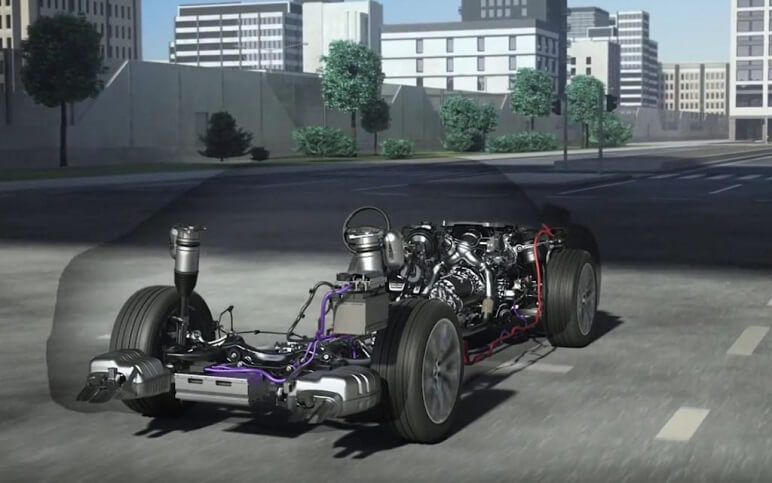
High-performance mechanical innovations introduced in the high-end automotive sector are increasingly to be considered as important legacies of the intense research and development activities sustained in the field of Formula 1.
One such technology that has recently been integrated into the design and production of commercial automobiles is active suspension. In addition to significantly improving the comfort of the driving experience, these mechanical devices also make an important contribution to the safety of those on board a car that is equipped with them.
Before going into detail, it is appropriate to specify precisely what is meant by active suspensions, indicating what are the mechanical components that make them different (in some ways opposite) from passive suspensions.
The most widespread and widely used suspension in the automotive sector is undoubtedly the passive one, thanks to which the transfer of relative motion between the road surface and the cockpit of the car can be modeled through a classic system Mass (M) - Spring (K) - Damper (r). The "passive" attribute is due to the absence of components that can actively perform work, but only absorb it in the case of the spring and dissipate it through the damper.
With active suspension we mean therefore a mechanical organ that manages the relative motion of the car with respect to the ground thanks to the presence of a motor able to regulate the distance between the passenger compartment and the axis of the wheel (and consequently, from the road floor). From this simple description it is possible to make some rather immediate considerations.
The innovation in question, of this level of advancement, is currently destined only for cars of a higher quality level, and one of the reasons is rather immediate: having to replace four passive components with as many components each with an independent motor involves a decidedly substantial cost. However, although this qualitative leap seems to be particularly costly, it is certainly not the one that has the greatest impact on the exclusivity of the technology, and to understand this it is enough to think of a term just used, namely "independence".
The four motors must be managed independently, which requires the installation of a dedicated on-board computer. A control unit processes and calculates the elongations of the actuators after analyzing the information collected by strategically placed sensors in order to scan the driving scenario in the smallest details, taking into account obstacles such as potholes or bumps, all at a frequency of 18Hz, or 18 "corrections" per second.

La complessità nel garantire il corretto funzionamento di un sistema così preciso dal punto di vista informatico, fa quasi passare in secondo piano la meccanica che si basa sul singolo attuatore. Esso è composto da un motore elettrico in grado di applicare una coppia pari a 1100 Nm su un puntone in titanio che tramite una filettatura è in grado di trasformare cinematicamente la rotazione in una traslazione verticale. È chiaro che, in questo nuovo sistema di approccio alla sospensione, i componenti caratteristici quali molla e smorzatore non sono stati eliminati del tutto, la loro presenza risulta comunque fondamentale al fine di garantire elasticità alla struttura.
In sintesi, il concetto di “sospensione attiva” racchiude al suo interno lo sfruttamento e l’ottimizzazione delle sinergie della nuova e della vecchia tecnologia, avente come obiettivo la massimizzazione delle prestazioni fornite da entrambe le protagoniste. Questa efficienza costruttiva ha visto una prima concretizzazione nel 2018 in occasione della presentazione e commercializzazione dell’Audi A8, fino a raggiungere livelli di perfezione nella solita Mercedes Classe S, soprannominata da sempre “L’ammiraglia”, nella sua ultima versione, presentata nell’appena concluso 2020.
If you have had the good fortune to try the experience personally, you have undoubtedly realized the feeling of lightness that you get when driving cars of this caliber, almost as if you were not moving on a road, inevitably provided with its imperfections, but on the floor of a shopping mall, perfectly smooth and level. This sensation is nothing but the result of the functioning of such suspensions and the ability they have in literally isolating the structure of the car from the surrounding environment. A more analytical confirmation of what has been described can be observed in the following graph, obtained from a numerical simulation in Simulink, in which the objective was precisely to compare the disturbances transmitted to the chassis by a passive suspension system (blue curve) compared to active suspensions (yellow curve).

A further guarantee for cars such as those under consideration is safety, which has been further improved thanks to the use of these suspensions, particularly in relation to accidents caused by side impacts. As soon as the lateral sensors detect the approach of material bodies at a speed of 25 km/h or more, the control unit commands an impulsive raising of the side panel by 8 cm. This amount is sufficient to ensure that a good part of the energy due to the impact is discharged on the lower part of the frame of the structure, which is the most rigid, limiting the stress suffered by the passengers of the car by about 50% in particularly critical areas such as chest or skull.
The incipient diffusion of such a complex technology still makes it an elite good, but in view of the great benefits it is able to bring, it also seems useless to say that it will be widely developed and improved in the future, so as to make it accessible to everyone and make moving on land safer and more pleasant.
Written by Lorenzo Campioni of the VGen Engineering Hub