

With Einstein, the relativistic concept of 'time' has revolutionized the way to interpret reality, creating an irreparable split with classical physics, suitable to describe only small speeds. What if Einstein had not closed a chapter of physics, but had simply created the conditions to open a new one?
Griffith University, along with colleagues at the "National Measurement Institute"(NMI), plans to find a practical fit to a theory published in 2016 by physicist Joan Vaccaro, which proposes a revolutionary interpretation of time as a violation of natural symmetries. Her theory is exemplified by the description provided by Michael Irving (New Atlas), which emphasizes the following analogy:
“Joan Vaccaror uses the analogy of a tree blowing in the wind—while the leaves (entropy) may appear to be shaking the tree, they aren’t responsible for the motion themselves, but are the result of another force (wind). In this new theory, the ‘wind’ is created by time reversal symmetry violations (T violations).”
The particles involved in the investigation are neutrinos, fascinating corpuscular entities, but shrouded in mystery. Peter Debye, a Dutch physicist, defined the ambiguity of neutrinos as follows:
<<Neutrinos? ”Oh, that’s a problem like new taxes, one had best not think about it at all”.>>
Neutrinos, in their basic dichotomy, will be the protagonists of a new current of thought, that for the first time doesn't recognize in time the effect of entropy of Universe, but the cause. In particular, the experiment will aim to reveal a time dilation on quantum scale. It is based on the idea that neutrinos are able to interfere with time as if the latter was a physical entity in itself, exhibiting a violation of symmetry as a result of interference.
The experiment, based in Sydney, involves the generation of a stream of anti-neutrinos by the OPAL reactor, made available by the Australian Nuclear Science and Technology Organization (ANSTO); in addition, two clocks will be placed at different distances from the reactor core.
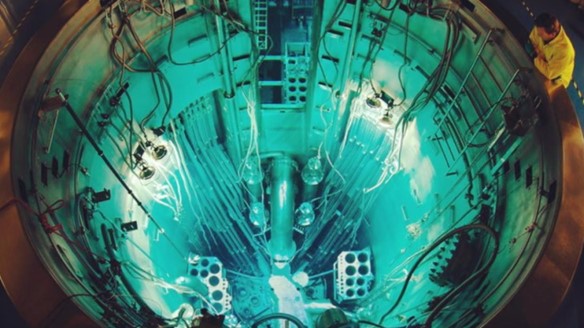
According to the theory, the measurement performed by a clock would depend on the symmetry violation suffered locally and the time dilation on the distance from the nucleus. The nearest clock (placed at 5 meters) would then reveal a non-synchronous measurement compared to the other (placed at 10 meters).
The clocks involved in the experiment will be cesium atomic clocks, chosen for their high accuracy and precision in detecting small effects on quantum scale. Prerequisite in order not to compromise the reliability of the experiment is that neutrinos and clocks are placed in the same physical-environmental conditions, because, otherwise, the particles could undergo changes (for example related to temperature). The difficulty of the experiment, in fact, is the unpredictability of the environment, in contrast with the controllability of an experiment conducted in the laboratory.
The experiment has been defined a 'high risk' by one of the collaborators, because it crosses the threshold of the temporal-quantum unknown: if the measurements, collected for six months, were to confirm the initial theory, would show that matter-neutrino interactions depend on time and not only on the weak nuclear force: in this case, it would be necessary to find a 'number' that estimates how significant is the quantum effect on time itself.
In conclusion, the experiment could bring to the forefront the fact that the dynamics observed every day are not part of nature, but phenomenological occurrences that occur under certain conditions of symmetry violation.
Is it nature that creates time or time that creates nature? The experiment will not provide the answer, but hopefully it will shed some light on the question.
Written by Federica Valeria Didonna of the VGen Engineering Hub


