

“Any time is a good time to start a company.” (Ron Conway, Angel Investor)
Well, Ron, are you sure? That might be a fairly understandable response to a quote that, to this day, seems almost anachronistic. In fact, the spread of the Covid-19 virus around the world has marked a drastic change in life in all respects; this state of emergency has caused the closure of most non-essential economic activities and lockdowns in most countries around the world, with disastrous consequences on the economy. In this sense, what has been the response of the Venture Capital (VC) industry and how have national and supranational authorities, in particular the European Union, responded?
But let's proceed one step at a time: what is meant by Venture Capital?.
As is well known, Venture Capital (VC) is a form of Private Equity (PE) that originated at the end of World War II and has developed into a sophisticated industry with numerous players and an important role in stimulating innovation. It is used by investors to provide capital to startups and small private companies with promising growth prospects. This capital can be allocated at different stages of the company's life and in multiple rounds. Specifically, what makes VC funds different from PEs is the stage at which investments occur. For VC, this happens in the early stages of a company's life when it needs to fund itself and grow. In the case of PE on the other hand, this happens in advanced stages to further grow, consolidate and expand.
The most important realities of this industry are specialized funds, angel investors and companies, active through Corporate Venture Capital. The former, Venture Capital funds, collect capital from investors and use specific knowledge to allocate it to companies. The latter, entrepreneurs or individuals with large amounts of capital in search of income, on the other hand, allocate their own capital usually in the start-up phase of their activities. Funds can be transferred in multiple rounds and most of the time investors take an active role in the companies to ensure that predefined plans and strategies are followed.
Corporate venture capital (CVC), which is the direct investment by a company in a startup, is a separate issue. The CVC arises mainly from the need of companies to expand, integrate vertically or promote the development of innovative products that allow the growth of their business (open innovation). For this reason, investments are often concentrated in sectors similar or complementary to the one in which the company that makes them operates. The modus operandi consists of entering into the capital through the acquisition of a minority share that can later evolve into a complete acquisition. The advantage of this practice over internal development or immediate acquisition are the lower risk and greater innovative drive, which is easier to preserve in an agile startup than in a multinational. Among the most active multinationals in this field are Google (Google Ventures), Intel (Intel Capital) and Qualcomm (Qualcomm Ventures).
Although Venture Capital investments are particularly risky, they are extremely attractive due to the return they are able to generate. In fact, it is believed that for ten investments, four fail completely, four or five return the initial capital and only one or two produce significant results, giving investors an IRR (Internal Rate of Return, used to measure the profitability of an investment) equal to 15/20% of the total initial investment. From the point of view of entrepreneurs, however, this type of financing is becoming progressively more important. In some cases, in fact, the VC is the only source of financing that companies can afford, and despite the fact that access to these funds entails a reduction in the company shares held by existing partners, the capital obtained is not subject to any form of guarantee and therefore guarantees those who obtain it the widest room for manoeuvre.
Regardless of the type of investor, the business model linked to this type of investment foresees that the capital allocated is disinvested within a period that does not exceed, typically, ten years. The modalities through which the exit from the investment takes place are limited to the sale of shares to other shareholders, to the start-up of an M&A activity, or, more infrequently, to an IPO on the markets, depending on the phase of life of the company itself and on the investor's objective.
After this quick and dutiful introduction, we can move on to the topic of interest of this article: the exceptional moment that the VC sector is going through, witnessed by the ability of the sector to grow in such a delicate moment of recent history. Venture capital in Europe continues, in fact, to grow at a sustained pace despite the macroeconomic difficulties linked to the VOCID-19 pandemic.
After a stasis in the first half of the year due to the effects of the health emergency and the resulting global economic uncertainty, capital flowed freely into Europe in 2020 and the value of invested capital grew significantly, exceeding that recorded in previous years.
Recently PitchBook, published the 2020 Annual European Venture Report, which notes that last year the value of venture capital deals was 14.8% higher than in 2019: €42.8 billion, 9,341 deals, a new record.
The numbers of VC in Europe: geography and sectors
In spite of European growth as a whole, the great heterogeneity that has historically characterized the countries of the old continent in cultural and economic terms, reappears also in the type and value of investments both in quantity and in annual delta.
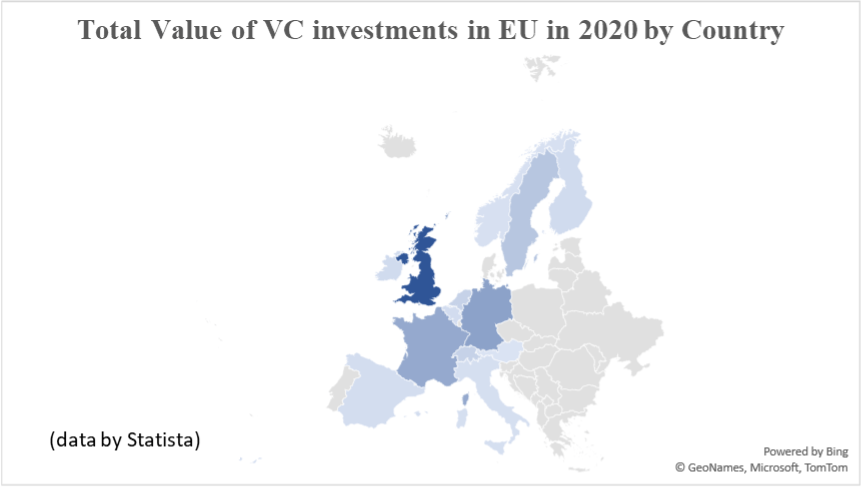
According to Statista's data for individual countries, despite the UK growing by only 1.7%, it remains the European leader in VC, with some €13.5 billion invested and 5 new Unicorns in 2020 alone. However, the UK's (previously undisturbed) dominance is being challenged by one of Europe's fastest-growing areas - DACH. German-speaking countries are in fact growing at a rapid pace. In particular, despite Austria lagging behind Germany and Switzerland with "only" €210 million invested, the amount of investment has grown by 58.1% over 2019. Germany and Switzerland in the same period, for invested capital of 6.3 and 1.8 billion show a growth of about 10%.
Among European countries, France and Benelux are third in terms of activity. In France the government has announced the creation of a fund to support the digital economy and startups. In the Benelux region, growth in the Netherlands (about +38%) offsets declines in Luxembourg and Belgium (-23% and -18.1%).
In Northern Europe, the Scandinavian countries confirm the positive trend of investments in VC. Sweden is in fact the fourth European power in this field, and Norway has seen an overwhelming +73.9%, the highest value on the continent. At the center of the Eastern European panorama is Estonia, with 360 million euros invested. Finally, Spain confirmed its position as the queen of VC in Southern Europe with 790 million euros of VC investment (+13%).
At €26.5 billion, deals larger than €25 million accounted for 61.8% of the total invested. CureVac's €560 million late-stage round was the largest deal of the year. But still, Klarna, Deliveroo, N26, Revolut and Northvolt signed deals worth more than €500 million, when only two companies raised that amount in 2019.
Globally, as expected, the U.S. still leads with $156 billion invested in startups, a value that is on the rise, higher than 2019's $138 billion. Interestingly, late-stage companies contributed about one-third (28.8%) of the number of deals and about two-thirds of the total value. In contrast, seed stage investments and early stage financings declined significantly. Similar data emerged in the European market.
In spite of the gap between the European and American markets, synthetically identifiable in the tradition of European startups to use banking instruments as a source of funding, European figures are in continuous and constant growth, making Europe the promised land of VC.
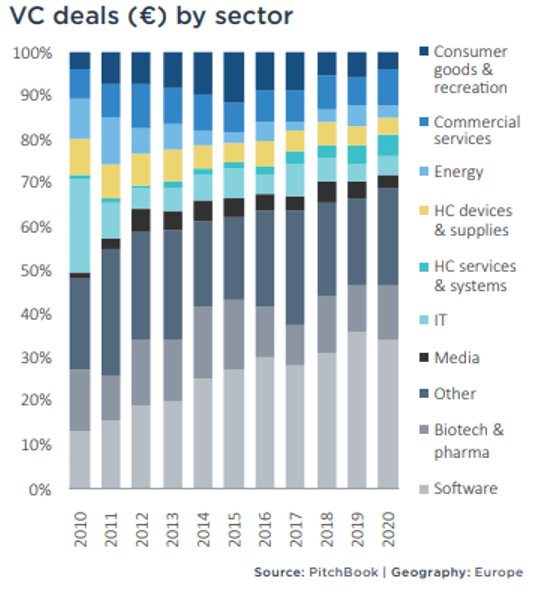
That said, one question arises: in which sectors are VC investments in Europe mainly channelled? The answer given in Pitchbook's European Venture Report is clear: with 14.5 billion euros invested through 2123 deals, the software sector covered about 33% of total investments, growing in the amount of capital allocated (+7.9%) but decreasing by 22.3% in the number of deals. In second place are investments in biotech and pharmaceutical startups, which amounted to 5.4 billion euros (about 12.5% of the total), with a growth of 41.1%, particularly in Germany.
An interesting trend concerns the healthcare sector, which in the last decade has witnessed a change of course: in particular, there is an inverse trend between the offer of devices (in sharp decline) and services (whose growth also appears to be in line with the increasingly strong trend of the service economy) as indicated in the KPMG Venture Pulse Q3 2020. The latter category includes Babylon Health (UK) and Doctolib (FR), two telemedicine startups that have seen significant growth in the last year, encouraged by the healthcare emergency.
Focus on: CVC
Shifting the focus to Corporate Venture Capital, we see how it has caused, along with the rest of VC, a substantial increase in investment over the past decade, in the US as well as in Europe. According to PitchBook's annual report on VC in Europe, the value of European deals with CVC participation increased from 15.6 billion in 2019 to 19.4 billion in 2020, confirming the strong positive trend already shown in previous years. Many of last year's largest European deals, including the aforementioned €560 million investment round of CureVac and the €527.6 million investment round of Deliveroo, featured CVC participation, particularly active in the Software and Biotech&Pharma sectors.
The CVC activity has not slowed down its growth despite the situation imposed by the pandemic, which has offered, along with new difficulties, further possibilities and an acceleration of innovation processes. The new needs dictated by the reduction of travel and social distancing have in fact led companies to invest in startups that innovate in this sense. An emblematic example of this phenomenon is Hopin, a London-based online events platform whose backers include Salesforce Ventures. The startup has seen meteoric growth during the 2020s, facilitated by pandemic-related restrictions, but it's unclear whether this growth could be dampened by the easing of restrictive measures. Regardless of the success of individual startups, the CVC phenomenon will continue in its upward trend: the numerous advantages in both economic and strategic terms make it a key element to compete in an increasingly fast-paced and dynamic market.
So, it seems that Ron Conway is not so wrong about VC in Europe, where indeed the response to an unprecedented pandemic has been very encouraging.
But what about Italy?
As it is explained by Meneghello (“Venture capital più forte del Covid: investimenti a 650 milioni nel 2020”, Il Sole 24 Ore,, February 17, 2021) actually the impact of Covid on Italian Venture Capital has been less than expected: in fact, this sector has confirmed the good results of 2019 with an amount invested of about 650 million euros. Despite the uncertainty of the markets, therefore, the VC is confirmed to be in strong growth, also thanks to the full operability reached by the Fund "Italia Venture II - Fondo Imprese Sud" and the Fund "Acceleratori", both managed by Cassa Depositi e Prestiti Venture Capital SGR.
Innocenzo Cipolletta, president of AIFI (Italian Association of Private Equity and Venture Capital), pointed out that inevitably there was a slowdown in the market in the first months of the pandemic, but that in the second part of the year the recovery was higher than expected. At the end of the year, the number of transactions was higher than in 2019; this is because there was a reduction in the average transaction size. Therefore, the pandemic crisis impacted with a slippage of larger deals to prioritize smaller deals.
Another very important role in this period has been played by the figure of business angels; in fact, the number of investments made in syndicate with venture capital has doubled. In particular, out of the total 650 million investments monitored by Vem, about 270 are attributable to venture capital investors, down from 366 in 2019, while 325 million, (against 230) concern as mentioned the interventions made in collaboration with business angels. The latter in turn made 51 million investments (in line with the previous year's figure) without cooperation with funds. These results mark an extremely positive element for the future, especially within a regulatory framework that remains particularly favorable after the raising of thresholds linked to tax deductions.
With regard to the geographical distribution of VC investments in Italy, historically problematic given the economic dominance of the North with respect to the rest of Italy (i.e., the double speed of the Belpaese), there is an extremely positive trend in the South, where the birth rate of startups is now higher than that of Italian companies. This, in addition to highlighting how the support given to the South in the form of tax relief is bearing fruit, could also be linked to the phenomenon of the migration of startups from the canonical centers of aggregation such as Milan and Rome (for further study, see "Innovation and Success away from metropolitan cities").
Despite the growth trend in investments, especially in the early stage, and the renewed contribution of public resources from the CoP, corporate venture capital remains a cumbersome mechanism; moreover, this process is much weaker in Italy than in Europe. It is therefore necessary to stimulate this type of investment in order to improve and perfect Italian VC, particularly in the "late" phase and in the capacity of these sources to renew the universe of Italian companies in general.
A plan for the future: the proposal of the European Union
As for the EU, in order to help repair the economic damage caused by the pandemic, the European Commission, the European Parliament and EU leaders have agreed on a European recovery plan to exit the crisis and lay the foundations for a more modern, sustainable and equitable future. This plan includes two main measures: a new long-term budget, aimed at enhancing flexibility mechanisms, and the Next Generation EU program, a temporary tool designed to stimulate recovery with a 750 billion euro injection into the economy. These two main measures provide a stimulus package for the economy unprecedented in the history of the European Union.
As for Venture Capital, it falls within an investment program born in January 2019 under the name InvestEU Fund, which builds on the success of the Juncker Plan, which between 2015 and 2020 has provided more than €500 billion to support European economies. The InvestEU Fund aims to mobilize more than €372 billion in public and private investment through a €26.2 billion EU budget guarantee that supports investments by implementing partners such as the European Investment Bank (EIB) Group and other financial institutions. The allocation of the Next Generation EU will also bring an additional €5.6 billion to this fund. It will be available in the form of loans, guarantees and equity, and final beneficiaries will also be able to obtain it through financial intermediaries, including banks and venture capital funds.
Another point on which the EU is particularly pressing is the reduction of the fragmentation of ecosystems, a real obstacle for the growth of startups in the old continent. In this regard, on the occasion of Digital Day 2021, which took place on March 19, 24 signatory countries committed to supporting the launch of the EU Startup Nations Standards (SNS). It is an international declaration that aims to ensure startups born in EU countries the best practices underlying the most successful ecosystems in Europe and worldwide, with the intention of doubling by 2030 the number of unicorns (i.e. startups that reach a valuation of at least €1 billion).
The need for such an agreement stems from the fact that, although there has been an increase in the number of unicorns in recent years, the overall picture remains unsatisfactory: while 36% of global startups are based in Europe, only 14% of global unicorns are located here. What's more, the distribution of investments remains an extremely critical point because it is mainly done on a local basis. This trend is linked to the fact that each country has its own regulations and in practice limits the free movement of capital. In addition, investors prefer countries where regulation guarantees greater probability of success for their investments by allocating their resources to countries with more permissive and/or advantageous regulatory frameworks.
In this sense, the SNS aims to unify European ecosystems with a number of measures:
– Facilitazione e velocizzazione della costituzione di startup;
– Attrazione e capacità di trattenere i talenti;
– Riconoscimento delle stock option senza diritti di voto per le startup;
– Innovation in regulation understood as bureaucratic simplification for nascent projects;
– Accesso ai finanziamenti;
– Digital First understood as daily interaction between startups and authorities aimed at digital;
– Inclusione sociale, diversità e protezione dei valori democratici.
The importance of the SNS is therefore linked to the search for an integration of European ecosystems with the aim of creating a more efficient capital market, open and similar to a reality like the American one, where startups have easy access to capital from any federal state.
But then, what does this all mean? What should we expect?
In a very famous 2012 paper, Robert Gordon argued that growth in the United States was essentially over, and that innovations today are no longer as disruptive and impactful as electricity and the steam train had been in their time. This contribution has led to the creation of the fringe of so-called techno-pessimists, whose thinking also extends, clearly, to Europe. However, as illustrated above, nowadays both in the States and in the Old Continent there is an increasing attention to investments in such a highly innovative part of the economy as VC, which might make the American economist's statement (at least for the moment) far from the truth. In fact, confidence in European startuppers (and more generally entrepreneurs) probably represents the only real way to stem the feared slowdown in technological growth, which would lead to very tragic consequences for each individual country. And if not even an unprecedented pandemic has stopped this trend, it means that everyone, from Private Equity funds to Angel Investors, from single states to the European Union, up to multinational companies, have realized that this is the right path to take.
(So, we agree dear Ron: even now is a great time to start a business!)
Written by Luca Mocci, Gianni Morelli, Pietro Toso, Federico Perra and Giovanni Bursi of the VGen Bocconi Students Innovation Hub


