

Year after year, giant strides are being made in the field of biomechanics. In particular, one of the most advanced sectors concerns the realization of mechanical exoskeletons, able to support the operator's body in remarkable activities. The application of this technology is limitless: from industrial to hospital use, from civil works to domestic use, from automotive to logistics.
There are several prototypes offered on the market with very different designs. Not surprisingly, some resemble the Ironman armor built by Tony Stark.
This is the case of MATE-XT, the exoskeleton produced by Comau, a Turin-based company from the FCA group, global leader in advanced solutions for industrial automation, which recently marked an important milestone in the dissemination of passive robotic support technology: it is the first exoskeleton on the market to have obtained EAWS (Ergonomic Assessment Work-Sheet) certification. The project has been developed in collaboration with IUVO, a spin-off company of the Institute of BioRobotics of the Scuola Superiore Sant'Anna in Pisa, and ÖSSUR, an Icelandic company leader in the field of non-invasive orthopedic devices.
The exoskeleton is worn as if it were a backpack, the robotic support consists of 3 basic components: the carbon spinal structure, the high-tech lumbar band that allows an intuitive lacing system, and the mechanical arms. They are hinged at shoulder height and secured to the arm by a lace at elbow height.
The materials used allow to keep the weight of the entire device on 4kg (which can vary by a hundred grams depending on the size).
The movement of the device is made possible thanks to a careful study of the degrees of freedom granted by the hinges. The MATE-XT is a passive device, so there are no motors, but the supporting action in lifting is through the Torque Generator Box (TGB): "a mechanism capable of storing and transforming the potential mechanical energy of a series of pre-tensioned springs in order to create a variable assistive torque for the arm. Assistive torques are maximized for flexion angles of approximately 90°." In addition, the control system provides 8 force management patterns depending on use.
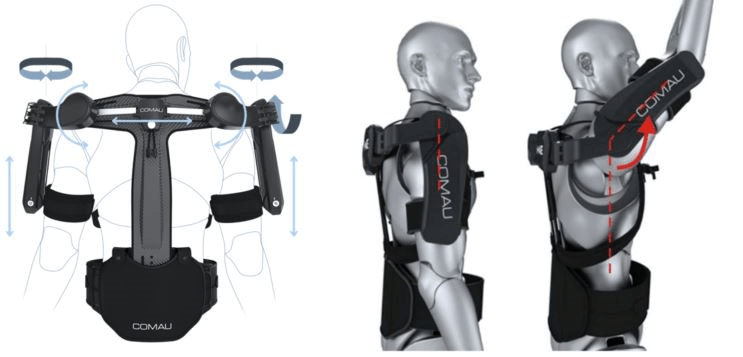
The concept behind a passive robotic system is to support the user in his routine actions, it should not be thought that such a device allows to lift loads higher than normal, but acts only as an articular and postural support.
The design was initially conceived to allow assembly line workers to work while minimizing physical exertion. Typical applications for the MATE-XT include a range of operations that would force the operator to hold an ergonomically incorrect position for a prolonged period of time, for example, in the automotive sector, all those operations carried out under the body.
Test results show improvements in all aspects: reduced operator muscle strain, improved posture, reduced cycle times, increased work accuracy. This could lead a company to provide such a device to employees from the production department and return on investment rather easily.
We don't have to stretch our imagination too far to find additional work conditions where using the device is a net benefit: nurses and healthcare workers often have to lift patients in providing care, or they have to transport medical supplies from one department to another. In addition, studies have recently advanced on the possibility of using the MATE XT in the agribusiness industry.
In this regard, Comau executives believe that over the next 5 to 10 years, the use of passive robotic media will experience a growth rate of about 40 percent, half of which will be for the industrial sector alone.
Written by Alessio Capone of the VGen Engineering Hub


