Tag: tecnologia

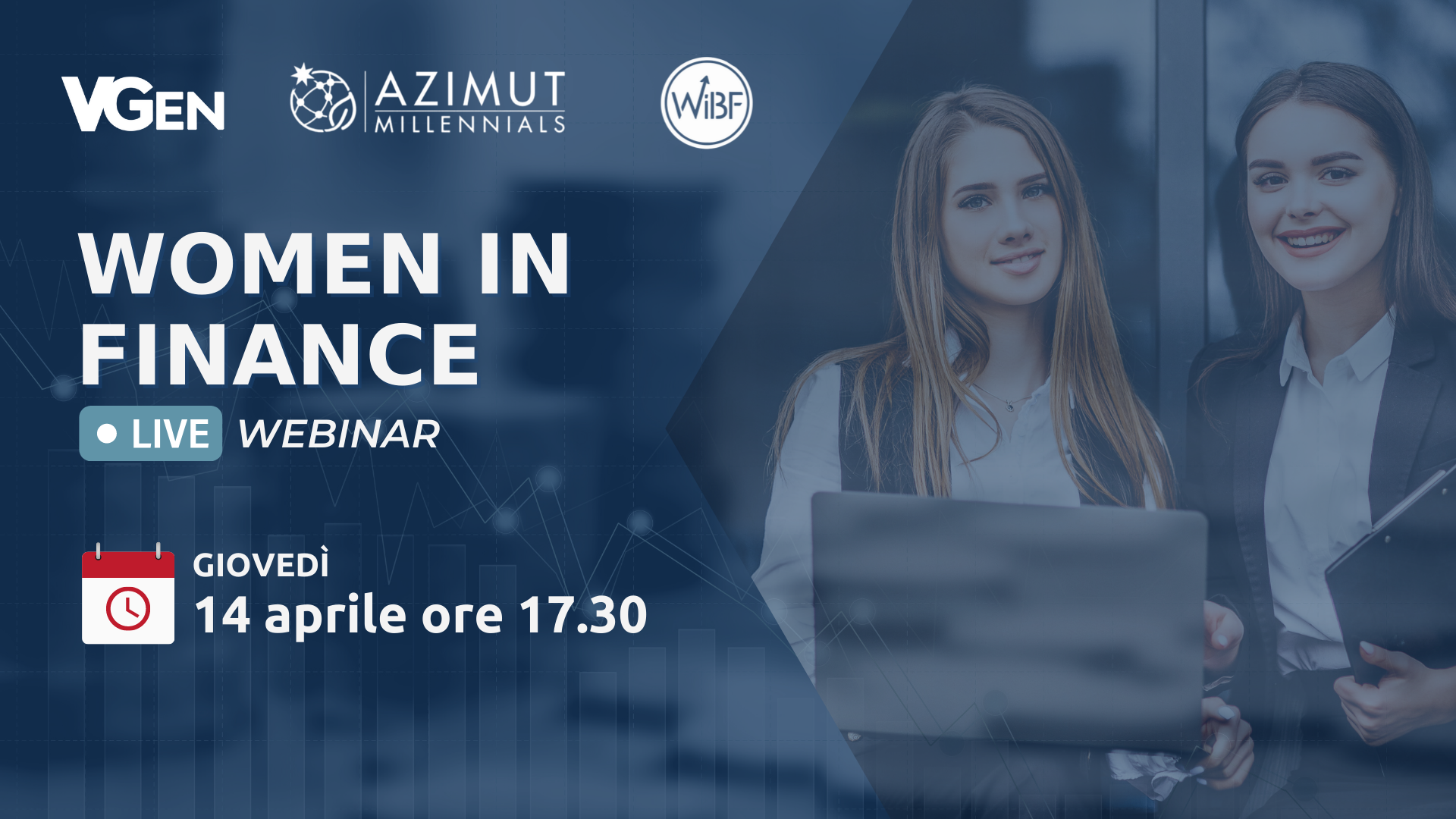
  • Women in Finance | Live Webinar

    Women in Finance | Live Webinar

    LIVE WEBINAR

    Women in Finance

    L’evento che affronta il tema della parità di genere nel mondo della finanza

    14 APRILE ORE 17:30

    Un confronto sulle opportunities e le sfide per ridurre il gender gap nel settore della finanza

    IL TEMA:

    Il termine FinGap si riferisce al divario di genere presente, ormai in maniera sistematica, nel settore finanziario. Infatti, non solo le donne sono sottorappresentate ai vertici degli istituti bancari, nei consigli esecutivi ed in quelli di amministrazione, ma sono anche molto meno formate in termini di educazione finanzaria. Come arginare questo gap di genere? E quali sono le opportunità e le sfide per le donne che vogliono farsi spazio nel settore della finanza?


    LE SPEAKERS:

    Tatiana Ancona       Financial Partner presso Azimut Capital Management SGR S.p.A.
    Dopo un’esperienza bancaria ventennale, si avvicina al mondo della consulenza finanziaria per una esigenza di crescita professionale e di ricerca di  libertà d’azione con i clienti. Ricopre inoltre un incarico manageriale in Azimut di supporto al progetto Millennials per l’Area Triveneto. 

    Elisabetta Sala        Financial Partner presso Azimut Capital Management SGR S.p.A.
    Lavora a Milano nel mondo della consulenza finanziaria da 6 anni, è una professionista certificata EFPA. Attualmente ricopre una carica istituzionale nel Comitato Nazionale di ANASF giovani ed è consigliere nel Comitato territoriale della Lombardia. Ha conseguito la Laurea Magistrale in Economia e Finanza a Roma.

    Eleonora Morelli      Head of Politics & Lobbying @WiBF
    Laureata in Scienze Bancarie, Finanziarie ed Assicurative presso l’Università Cattolica del Sacro Cuore, si avvicina al mondo del fintech, dove attualmente lavora, durante gli studi universitari. Durante l’esperienza universitaria, entra a far parte di Women in Business and Finance, in cui si occupa di relazioni verso l’ecosistema partner.

    Angelica La Rosa     Talent Acquisition Team Leader @WiBF
    Dopo la laurea in International HR Management, inizia la sua esperienza lavorativa come recruiter in ambito finanziario, dove supporta le attività di selezione e formazione di talenti. Dal 2019 entra a far parte di Women in Business and Finance, in cui si occupa tuttora del recruitment di nuove associate.


    Un confronto sulle opportunities e le sfide per ridurre il gender gap nel settore della finanza

    IL TEMA:

    Il termine FinGap si riferisce al divario di genere presente, ormai in maniera sistematica, nel settore finanziario. Infatti, non solo le donne sono sottorappresentate ai vertici degli istituti bancari, nei consigli esecutivi ed in quelli di amministrazione, ma sono anche molto meno formate in termini di educazione finanzaria. Come arginare questo gap di genere? E quali sono le opportunità e le sfide per le donne che vogliono farsi spazio nel settore della finanza?


    LE SPEAKERS

    Tatiana Ancona 
    Financial Partner presso Azimut Capital Management SGR S.p.A.

    Dopo un’esperienza bancaria ventennale, si avvicina al mondo della consulenza finanziaria per una esigenza di crescita professionale e di ricerca di  libertà d’azione con i clienti. Ricopre inoltre un incarico manageriale in Azimut di supporto al progetto Millennials per l’Area Triveneto. 


    Elisabetta Sala
    Financial Partner presso Azimut Capital Management SGR S.p.A.

    Lavora a Milano nel mondo della consulenza finanziaria da 6 anni, è una professionista certificata EFPA. Attualmente ricopre una carica istituzionale nel Comitato Nazionale di ANASF giovani ed è consigliere nel Comitato territoriale della Lombardia. Ha conseguito la Laurea Magistrale in Economia e Finanza a Roma.


    Eleonora Morelli
    Head of Politics & Lobbying @WiBF

    Laureata in Scienze Bancarie, Finanziarie ed Assicurative presso l’Università Cattolica del Sacro Cuore, si avvicina al mondo del fintech, dove attualmente lavora, durante gli studi universitari. Durante l’esperienza universitaria, entra a far parte di Women in Business and Finance, in cui si occupa di relazioni verso l’ecosistema partner.


    Angelica La Rosa
    Talent Acquisition Team Leader @WiBF

    Dopo la laurea in International HR Management, inizia la sua esperienza lavorativa come recruiter in ambito finanziario, dove supporta le attività di selezione e formazione di talenti.
    Dal 2019 entra a far parte di Women in Business and Finance, in cui si occupa tuttora del recruitment di nuove associate.


    Durante l’evento potrai:

    CO-ORGANIZZATORI:

    Azimut Holding S.p.A. 
    è una società indipendente, fondata a Milano nel 1988, che si occupa di consulenza e gestione patrimoniale. Dal 2004 è quotata nell’indice FTSE MIB della borsa di Milano ed è presente in 18 paesi nel mondo. Tramite il Progetto MIllennials ed attività come l’Azimut Tlaent Program, si impegna a formare ed accompagnare i giovani consulenti finanziari del domani.


    Women in Business & Finance (WiBF) 
    è un’associazione di giovani studentesse e professioniste italiane che condividono un forte interesse per l’economia e per la finanza con l’obiettivo di creare un network che permetta alle associate di condividere le proprie conoscenze ed esperienze nel mondo del lavoro, attraverso workshop, talk internazionali e seminari interattivi con donne di successo.


    CO-ORGANIZZATORI:

    Azimut Holding S.p.A. 
    è una società indipendente, fondata a Milano nel 1988, che si occupa di consulenza e gestione patrimoniale. Dal 2004 è quotata nell’indice FTSE MIB della borsa di Milano ed è presente in 18 paesi nel mondo. Tramite il Progetto MIllennials ed attività come l’Azimut Tlaent Program, si impegna a formare ed accompagnare i giovani consulenti finanziari del domani.


    Women in Business & Finance (WiBF) 
    è un’associazione di giovani studentesse e professioniste italiane che condividono un forte interesse per l’economia e per la finanza con l’obiettivo di creare un network che permetta alle associate di condividere le proprie conoscenze ed esperienze nel mondo del lavoro, attraverso workshop, talk internazionali e seminari interattivi con donne di successo.


  • Come realizzare un Talent Program efficace: l’esperienza di Azimut

    Come realizzare un Talent Program efficace: l’esperienza di Azimut

    LIVE WEBINAR

    Mercoledì 21 luglio ore 18.30

    Scopri il funzionamento di un Talent Program

    Attrai e fidelizza i best talent con un programma che combina online and offline

    In questo webinar analizzeremo il funzionamento di un Talent Program, quale strumento di Talent Acquisition ed Employer Branding strategy aziendale, soffermandoci sul case study di successo “Azimut Talent Program insieme ai referenti dell’azienda.

    speaker e agenda

    gallus

    marco gallus

    Responsabile Network Training & Development @Azimut

    alberto baldovin

    Responsabile Progetto Millennials @Azimut

    gabriele belfiore

    Co-founder & COO @VGen

    Gianmarco COmerci

    Head of Business @VGen

    AZIMUT TALENT PROGRAM IN NUMERI

    0

    ENROLLED

    0

    PAGE VIEWS

    0

    SOCIAL VIEWS

    AGENDA

    18:30 – 18:40 | INTRODUZIONE: COME SI È EVOLUTO IL RAPPORTO TRA AZIENDA E GIOVANI TALENTI – Gabriele Belfiore (VGen)

    18:40 – 18:50 | IL TALENT PROGRAM COME STRUMENTO DI TALENT ACQUISITION – Gabriele Belfiore (VGen)

    18:50 – 19:15 | L’ESPERIENZA DI AZIMUT – Marco Gallus e Alberto Baldovin (Azimut)

    19:15 – 19:30 | Q&A

    Moderatore: Gianmarco Comerci

    Le prenotazioni per questo evento sono chiuse!

  • Artificial Intelligence Virtual Internship| Evento finale Accenture

    Artificial Intelligence Virtual Internship| Evento finale Accenture

    LIVE WEBINAR – EVENTO FINALE

    Artificial Intelligence
    Virtual Internship

    Partecipa all’incontro conclusivo con il team di Artificial Intelligence di Accenture dedicato al percorso di Virtual Internship.

    7 LUGLIO ORE 16:00

    Scopri come Accenture ogni giorno applica e lavora con l’Intelligenza Artificiale

    WHAT THIS IS ABOUT

    L’AI è un aggregato di tecnologie — dal Machine Learning al Natural Language Processing — che permettono alle macchine di percepire, comprendere, agire e imparare.


    PERCHÈ É IMPORTANTE

    L’Artificial Intelligence trasformerà la relazione tra le persone e la tecnologia, potenziando la nostra creatività e abilità.


    WHAT IT WILL LEAD TO
     

    The future of AI heralds a new era of disruption and productivity, where human ingenuity is amplified by the speed and precision of machines.

    Durante l’evento potrai

    Compila il form and prenota ora il tuo posto per il Webinar

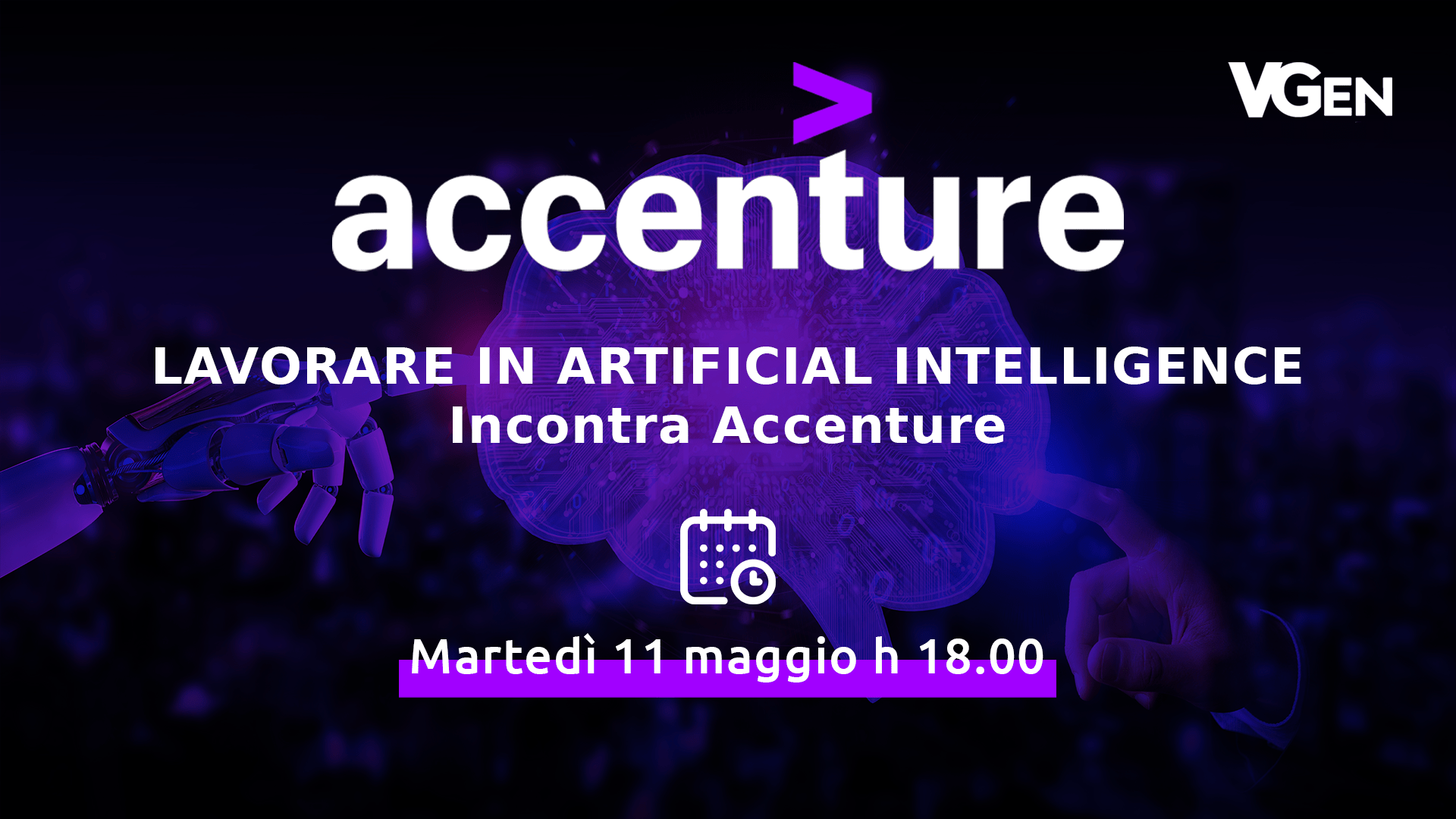
  • Lavorare in Artificial Intelligence | Incontra Accenture

    Lavorare in Artificial Intelligence | Incontra Accenture

    LIVE WEBINAR

    Lavorare in Artificial Intelligence

    Incontra Accenture

    11 MAGGIO ORE 18:00

    Scopri come Accenture ogni giorno applica e lavora con l’Intelligenza Artificiale

    WHAT THIS IS ABOUT

    L’AI è un aggregato di tecnologie — dal Machine Learning al Natural Language Processing — che permettono alle macchine di percepire, comprendere, agire e imparare.


    PERCHÈ É IMPORTANTE

    L’Artificial Intelligence trasformerà la relazione tra le persone e la tecnologia, potenziando la nostra creatività e abilità.


    WHAT IT WILL LEAD TO
     

    The future of AI heralds a new era of disruption and productivity, where human ingenuity is amplified by the speed and precision of machines.

    agenda

    18:00 – 18:05 | INTRO ELL’EVENTO

    18:05 – 18:15 | INTRODUZIONE AI PERCORSI LAVORATIVI IN ACCENTURE  

    18:20 – 18:30 | LAVORARE IN ARTIFICIAL INTELLIGENCE

    18:30 – 18:40 | FOCUS SULLA VIRTUAL INTERNSHIP IN AI 

    18:40 – 19:00 | SESSIONE Q&A

    Le prenotazioni per questo evento sono chiuse!

  • Sospensioni attive: tradizione ed innovazione

    Active suspension: tradition and innovation

    High-performance mechanical innovations introduced in the high-end automotive sector are increasingly to be considered as important legacies of the intense research and development activities sustained in the field of Formula 1.

    One such technology that has recently been integrated into the design and production of commercial automobiles is active suspension. In addition to significantly improving the comfort of the driving experience, these mechanical devices also make an important contribution to the safety of those on board a car that is equipped with them.

    Before going into detail, it is appropriate to specify precisely what is meant by active suspensions, indicating what are the mechanical components that make them different (in some ways opposite) from passive suspensions.

    The most widespread and widely used suspension in the automotive sector is undoubtedly the passive one, thanks to which the transfer of relative motion between the road surface and the cockpit of the car can be modeled through a classic system Mass (M) - Spring (K) - Damper (r). The "passive" attribute is due to the absence of components that can actively perform work, but only absorb it in the case of the spring and dissipate it through the damper.

    With active suspension we mean therefore a mechanical organ that manages the relative motion of the car with respect to the ground thanks to the presence of a motor able to regulate the distance between the passenger compartment and the axis of the wheel (and consequently, from the road floor). From this simple description it is possible to make some rather immediate considerations.

    The innovation in question, of this level of advancement, is currently destined only for cars of a higher quality level, and one of the reasons is rather immediate: having to replace four passive components with as many components each with an independent motor involves a decidedly substantial cost. However, although this qualitative leap seems to be particularly costly, it is certainly not the one that has the greatest impact on the exclusivity of the technology, and to understand this it is enough to think of a term just used, namely "independence".

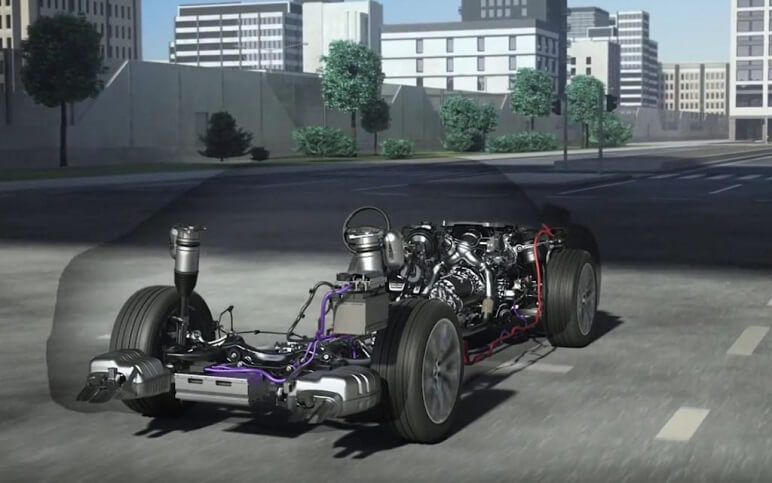
    The four motors must be managed independently, which requires the installation of a dedicated on-board computer. A control unit processes and calculates the elongations of the actuators after analyzing the information collected by strategically placed sensors in order to scan the driving scenario in the smallest details, taking into account obstacles such as potholes or bumps, all at a frequency of 18Hz, or 18 "corrections" per second.


    Active suspension's sensors


    La complessità nel garantire il corretto funzionamento di un sistema così preciso dal punto di vista informatico, fa quasi passare in secondo piano la meccanica che si basa sul singolo attuatore. Esso è composto da un motore elettrico in grado di applicare una coppia pari a 1100 Nm su un puntone in titanio che tramite una filettatura è in grado di trasformare cinematicamente la rotazione in una traslazione verticale. È chiaro che, in questo nuovo sistema di approccio alla sospensione, i componenti caratteristici quali molla e smorzatore non sono stati eliminati del tutto, la loro presenza risulta comunque fondamentale al fine di garantire elasticità alla struttura.

    In sintesi, il concetto di “sospensione attiva” racchiude al suo interno lo sfruttamento e l’ottimizzazione delle sinergie della nuova e della vecchia tecnologia, avente come obiettivo la massimizzazione delle prestazioni fornite da entrambe le protagoniste. Questa efficienza costruttiva ha visto una prima concretizzazione nel 2018 in occasione della presentazione e commercializzazione dell’Audi A8, fino a raggiungere livelli di perfezione nella solita Mercedes Classe S, soprannominata da sempre “L’ammiraglia”, nella sua ultima versione, presentata nell’appena concluso 2020.

    If you have had the good fortune to try the experience personally, you have undoubtedly realized the feeling of lightness that you get when driving cars of this caliber, almost as if you were not moving on a road, inevitably provided with its imperfections, but on the floor of a shopping mall, perfectly smooth and level. This sensation is nothing but the result of the functioning of such suspensions and the ability they have in literally isolating the structure of the car from the surrounding environment. A more analytical confirmation of what has been described can be observed in the following graph, obtained from a numerical simulation in Simulink, in which the objective was precisely to compare the disturbances transmitted to the chassis by a passive suspension system (blue curve) compared to active suspensions (yellow curve).


    Figure 1: X axis - advancement on any uneven road surface (randomly simulated)
    Y axis - vertical accelerations transmitted to the chassis


    A further guarantee for cars such as those under consideration is safety, which has been further improved thanks to the use of these suspensions, particularly in relation to accidents caused by side impacts. As soon as the lateral sensors detect the approach of material bodies at a speed of 25 km/h or more, the control unit commands an impulsive raising of the side panel by 8 cm. This amount is sufficient to ensure that a good part of the energy due to the impact is discharged on the lower part of the frame of the structure, which is the most rigid, limiting the stress suffered by the passengers of the car by about 50% in particularly critical areas such as chest or skull.

    The incipient diffusion of such a complex technology still makes it an elite good, but in view of the great benefits it is able to bring, it also seems useless to say that it will be widely developed and improved in the future, so as to make it accessible to everyone and make moving on land safer and more pleasant.

    Written by Lorenzo Campioni of the VGen Engineering Hub
  • HALO: La sicurezza prima di tutto… anche a 330 km/h

    HALO: Safety first... even at 330 km/h

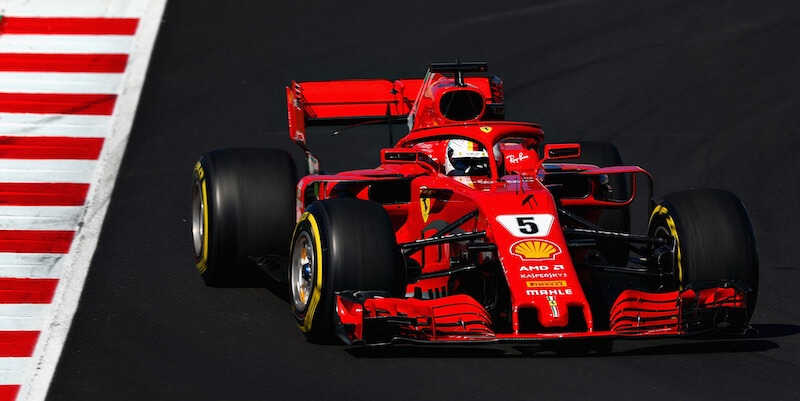
    In the technology industry, ensuring the safety of all operators is a priority. In the motor sport sector, the Halo system was introduced a few years ago.

    This is a titanium alloy structure positioned above the cockpit, in order to protect the driver's head. This system has greatly revolutionized the look of the single-seaters and, as in all traditionalist environments, the change was not well received at first; complicit in this is the fact that the vertical bar partially obstructs the driver's vision.

    Several events in which the HALO system proved to be fundamental have led the FIA (International Automobile Federation) to include the structure compulsorily on every single-seater from 2018 in both Formula1 and Formula2. Among the most well-known events are the one involving Charles Leclerc and Fernando Alonso in 2018, and the accident that saw Romain Grosjean impact the guardrail with the front of the single-seater. In the latter episode, the presence of the Halo made it possible to avoid any contact between the metal and the driver, who fortunately only suffered minor burns.

    The Halo is composed of three elements: the vertical bar, the central diadem and the side wings that connect to the rear body of the machine, thus constituting a double arch with three hinges, remarkably stable from a structural point of view.


    • STRUCTURAL ASPECT:
    • The material in question is Titanium Grade 5 6Al4V and has an elastic modulus of about 120 GPa at a density of 4,429 g/cm³, compared to a steel that has an elastic modulus of 210 GPa and a density of 7.5-8.0 g/cm³.The first negative aspect to consider is of course the increase in weight. Since it is a solid structure, it weighs about 15kg, which is a real problem in terms of performance. The structure itself is capable of withstanding exceptional loads of more than 5 tons. No wonder the system manages to protect the driver from an impact between two cars at high speed.


    Different aerodynamic solutions to minimize losses


    • AERODYNAMIC ASPECT:
    • Compared to the previous single-seaters, from the aerodynamic point of view the HALO system entails a rather significant loss. In particular, the ring reduces the amount of air destined for the engine cooling duct (i.e. the cavity located above the driver's head) and interrupts the flow towards the rear wing (which generates the vehicle's downforce). To minimize losses as much as possible, each team's engineering team developed the most aerodynamic profiles possible, introducing flaps, flow diverters, and even overlapping ring profiles.


    Written by Alessio Capone ed Alessandro Celli of the VGen Engineering Hub

  • Vetri fotovoltaici: una finestra sul futuro

    Photovoltaic glass: a window on the future

    The period we are living is full of challenges. Safeguarding the planet is one of them. What better way to pursue this goal than with technology that combines innovation, clean energy and functionality?  

    We are talking about photovoltaic glasses: a technology that has become interesting in the last period. With them you can replace traditional glass with glazed panels capable of converting incident and/or diffused light into electricity. They integrate perfectly into the structure of a building, becoming to all intents and purposes structural elements. This feature is very important: in fact, the current trend for buildings and skyscrapers is to design the outer shell covered with glass walls. This choice, causes significant dispersion and dramatically lowers the energy efficiency of the building.

    This new generation of glazing would make it possible to overcome these problems by generating electricity that can be used for air conditioning the building through reversible heat pumps in both winter and summer, as well as limiting the penetration of sunlight in summer through shading.

    The size and number of photovoltaic cells present determines the different glass configurations. These can be single, so as to have a more homogeneous glass with less shading, or agglomerated with disparate geometries.

    Looking to the future, glass panels are being studied that use nanoparticles to concentrate solar radiation towards the photovoltaic cells. Concentrating photovoltaic glass is glass that collects sunlight and directs it towards strips of solar cells placed at the edges of the glass. They are called "concentrating" because, like concentrating photovoltaic panels, they need a reduced surface area of photovoltaic cells compared to that of light collection, which is given by the entire extension of the glass pane. They can even achieve high concentration factors ranging from 40X to 100X, depending on the concentration technology used.

    Nanoparticle technology, on the other hand, concentrates only visible and ultraviolet light but not heat (which reduces the performance of conventional cells) on thin strips of silicon cells placed at the edges of the panel, i.e. where in normal opaque solar panels there would be the aluminum frame. A combination of fluorescent pigments and nanoparticles is used to direct light to the edge of the module in this particular implementation. Compared to classic silicon panels, these do not require direct light but work with diffuse light and use only 1/5 of the silicon, even only 1/10 in models that employ high-efficiency multi-junction cells. In addition, they have a remarkable electrical power, comparable to conventional photovoltaic panels, and achieve a conversion efficiency of light into electricity of 20%, far greater than traditional technologies. In this regard, in the future we will see implemented these panels in a glass version (transparent), so as to be used instead of glass windows in large buildings.

    Another perspective instead exploits the use of Fresnell lenses, with which it is possible to obtain concentration values an order of magnitude higher than traditional lenses (500X). Thanks to this ability, combined with devices that allow the panel to track the light source, high values of energy conversion efficiency can be obtained. It should be noted that in the latter case we no longer speak of solar glass but of classic panels, which, given their compactness, have the advantage of being much easier to install.

    There are numerous architectural projects undertaken which integrate photovoltaic glass into the structure of the building¸ for example, the pergola of Tanjong Pagar in the financial center of Singapore and the Dubai Frame, a building with a peculiar rectangular structure which recalls a framed photograph, situated in the Zabeel Park in Dubai.

    Written by Roberto del Bo of the VGen Engineering Hub

  • Employer Branding sui Social in trend | Live webinar

    Employer Branding on Trending Social | Live Webinar

    LIVE WEBINAR

    Employer Branding sui Social in trend

    TikTok, Clubhouse e Twitch, vale la pena esserci?

    Martedì 30 marzo ore 18:30

    TikTok, Twitch e Clubhouse

    Come le aziende dovrebbero utilizzarli per fare Employer Branding strategy tra le nuove generazioni?

    Sono i social più scaricati del momento, in particolare dalla Generazione-Z. Tutte le più importanti aziende si stanno chiedendo se valga la pena investirci in termini di Employer Branding strategy and Brand Awareness.

    Ma vale davvero la pena esserci? E quali sono i risultati attesi?

    Di questo e di casi studio reali parleremo nel prossimo live webinar targato VGen.

    speaker e agenda

    SARA GIGLIOTTI

    Talent Acquisition & HR Project Manager @Haier Europe
    FEDERICO ROGNONI

    TikTok Consultant & Creator and Social Media Manager

    arianna-chieli

    ARIANNA CHIELI

    Content Strategist & Influencer Marketing
    AGENDA

    18:30 – 18:40 | INTRO – Riccardo Madrigali (VGen)

    18:40 – 18:50 | IL FUTURO DELL’EMPLOYER BRANDING – Sara Gigliotti

    18:50 – 19:00 | COME CAMBIA IL RAPPORTO TRA L’AZIENDA E I PROPRI SEGUACI (EMPLOYEES E CONSUMATORI) – Arianna Chieli

    19:00 – 19:10 | TIKTOK, TWITCH E CLUB HOUSE: COME FUNZIONANO E COME ATTRAGGONO LE NUOVE GENERAZIONI – Federico Rognoni

    19:00 – 19:10 | Q&A

    Moderatore: Gaia Alaimo (Your Millennial Mentor)

    Le prenotazioni per questo evento sono chiuse!

  • Lavorare in una multinazionale Tech – Incontra IBM

    Working at a Multinational Tech Company - Meet IBM

    Scopri IBM e i percorsi di carriera adatte a te!

    5 speaker provenienti dal mondo IBM presenteranno le opportunità di carriera, i valori e il futuro della multinazionale leader dell’innovazione da oltre 100 anni.


    Live webinar gratuito con possibilità di interagire con gli speaker.

    TEMI & SPEAKERS

    Introduzione a IBM  – Monica Forbice

    Primi passi verso IBM – Elisabetta Dal Maso

    I valori di IBM – Floriana Ferrara

    Tecnologia IBM – Vittorio Carullo

    Testimonial – Najla Said

    JOIN

    Per partecipare compila il seguente form. Riceverai una mail con le istruzioni su come partecipare alla live.

Receive the report

Fill out the form to request the free report "Cosa cercano i talenti STEM dalle aziende." Our team will respond to your request as soon as possible!

vgen logo
Panoramica privacy

This website uses cookies so that we can provide you with the best user experience possible. Cookie information is stored in your browser and performs functions such as recognising you when you return to our website and helping our team to understand which sections of the website you find most interesting and useful.